
基本信息·出版社:清华大学出版社 ·页码:416 页 ·出版日期:2009年04月 ·ISBN:7302195013/9787302195016 ·条形码:9787302195016 ·版本:第1版 · ...
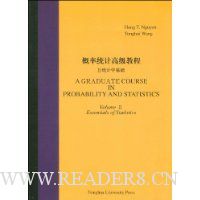
基本信息·出版社:清华大学出版社
·页码:416 页
·出版日期:2009年04月
·ISBN:7302195013/9787302195016
·条形码:9787302195016
·版本:第1版
·装帧:平装
·开本:32
·正文语种:中文
·外文书名:A GRADUATE COURSE PROBABILITY AND DTATISTICS VolumeII Essentials of Statistics
内容简介 《概率统计高级教程II统计学基础》是源亨和王通惠共同编著的。· This is an update Text book for beginning graduate students in Mathematics, Probability and Statistics, Engineering, Computer Sciences, Mathematical Economics
· It distinguishes from all existing texts on the subject from its pedagogical spirit, namely, motivations before mathematics; mathematics tools are only introduced when needed and motivated
· All theoretical results are proved in a friendly fashion
· Teaching the students, not only the concepts and possible applications, but also guiding the students with proof techniques
· This series will help students to learn with full understanding and appreciation of the subject
· It will provide interested students with solid background for research.
编辑推荐 《概率统计高级教程II统计学基础》由清华大学出版社出版。
目录
Preface
1 An Invitation to Statistics
1.1 A Motivating Example
1.2 Generalities on Survey Sampling
1.3 Statistical Data
1.4 Statistical Models
1.5 Some Computational Statistics
1.6 Exercises
2 Sampling Distributions
2.1 Sampling from a Bernoulli Population
2.2 Sampling from a Normal Population
2.3 Sampling from an Exponential Population
2.4 Order StatisticS
2.5 Distributions of Quadratic Forms
2.6 Exercises
3 Data Reduction
3.1 Sufficient Statistics
3.2 Complete Statistics
3.3 Exponential and Location-scale Families
3.4 Exercises
4 Estimation
4.1 Point Estimation
4.2 The Best Unbiased Estimation
4.3 Fisher Information and Efficiency
4.4 Two Methods of Finding Estimators
4.5 Confidence Sets
4.6 Bayes Estimation
4.7 Exercises
5 Large Sample Estimation
5.1 Consistency
5.2 Asymptotic Normality
5.3 Asymptotic Normality of Maximum Likelihood Estimators
5.4 Asymptotic Efficiency
5.5 Large Sample Interval Estimation
5.6 Robust Estimation
5.7 Exercises
6 Tests of Statistical Hypotheses
7 Nonparametric Statistical Inference
A Common Distributions
B Some Common Statistical Tables
Bibliography
Index
……
序言 This Volume II is the second half of a text for a course instatistics at the beginning graduate level. Statistics is a man-madescience aiming at assisting humans in making decisions in the faceof uncertainty. This science is built upon the rigorous theory ofprobability as described in Volume I. Thus, in studying this text,students should consult Volume I whenever needed.As stated in the preface of Volume I, there are various reasons to writeanother text in statistics at the introductory level. An obvious reason isto make the topic of statistics pleasant for students!In an introductory course in statistics such as this one, one canonly include basic ideas, concepts, procedures and applications at avery standard level. By this we mean that only the topics ofestimation, hypothesis testing and prediction are included. Also,all inference procedures are developed for the standard type ofdata, namely precise observations which are numerical orvector-valued. The students should easily recognize that it is thedata which dictate the developed statistical procedures in thistext. Thus, other types of data, such as censored data in survivalanalysis, missing data in questionnaires, coarse data inbiostatistics, imprecise data (or partially observed data, such asthose occurring in the problem of identification of DNA sequences inbioinformatics, using hidden Markov models), and perception-baseddata (which are expressed linguistically) will not be discussed.However, the methodology for precise data clearly indicates thegeneral framework for analyzing other types of data. After all,statistics is a science of data analysis.With the rapid advances of technology, the use of statistics hasbeen extended to many new emerging applications, both in physicaland social sciences. The text does not cover these new statisticaltechniques. The text is written as a pedagogical source forinstruction at universities. A solid understanding of statistics, atthe simplest level, will open the door for embarking on any newproblems which call for statistical assistance.
文摘 插图:

This introductory chapter aims at answering three basic questions Concern-ing the topic of statistics,namely“WHAT is statistics?”“WHY do ue needstatistics?“、and(HOW to carry out statistica\analysis?”.This text is about the foundation of the science of statistics.Statisticsis a body of concepts and techniques to carry out inductive logic in almostall activities of our daily lives.Although the applied concepts of the theory,such as experiment designs,sampling methods,and data analysis.will not bediscussed in a text such as this,we feel obligated to introduce the students tothe field of statistics from what statistics iS created for.1.1 A Motivating ExampleSuppose that we are interested in the annual income of individuals in thepopulation of Las Cruces,say,in 2004.Suppose that,for some reasons(suchas cost and time),we are unable to conduct a ce~u8(i.e.a complete enu-meration)throughout the whole population,and hence we could rely only onthe information about the income from a part of that population.Of course.before going out to do that.we need to prepare the ground carefully.Specif-ically,first we need to decide who to be included in the population.Sincethe variable of interest iS the annualincome,we should exclude,for example.children who do not work from the population.Next,we should worry aboutwhether or not when asking(by phone or by sending out questionnaires)se.1ected individuals,their answers are with or without errors.Then,in goingout to select a sample,a part of the population,we might want to conduct thesurvey in some beneficial way,e.g.by dividing the geography of the city intoappropriate zones.Au that iS part of what we call the design 0l experiments.For this applied topic,see a text like Dean and VoSS(1999).