
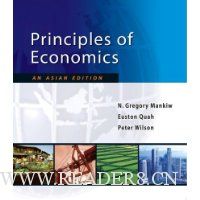
基本信息·出版社:Cengage Learning Asia
·页码:890 页
·出版日期:2008年03月
·ISBN:9814227870
·条形码:9789814227872
·版本:1st
·装帧:平装
·正文语种:英语
·外文书名:经济学原理 (进口原版全彩印刷)
内容简介 This is the Asian adaptation of N. Gregory Mankiw s market leading textbook Principles of Economics. While maintaining all the strengths of the original book, Professor Euston Quah and Dr. Peter Wilson have provided materials and examples that are most relevant to students in Asia. The book reflects Asian economic institutions and policy, features companies that operate in the region, and includes economic data from various Asian countries.
The text provides Asian students with a solid introduction to the principles and concepts of economics. It retains a strong international focus to enable students to place the Asian experience in a global context. Written for students taking economics for the first time, the book focuses on the core concepts and how these concepts are applied to the real world. Examples and cases throughout the text show students the relevance of the theory they are learning.
作者简介
曼昆简介
在格里高利·曼昆(Greg Mankiw)当学生的20年中,最令他兴奋的课程是他在上大学一年级时所选的连续两个学期的经济学原理。可以毫不夸张地说,这门课改变了他的一生。
普通教育的目的之一是让人们更多地了解世界,使其成为好公民;经济学的学习服务于这个目的。
曼昆生长在一个经常在饭桌上讨论政治问题的家庭中,对解决社会问题各种方法的支持与反对经常会引起家人热烈的争论。但在学校里,曼昆却被科学所吸引。政治问题看来是模糊的、不连贯的和主观的,而科学是分析的、系统的和客观的。当政治争论还在喋喋不休地进行时,科学却取得了进步。大学一年级的经济学原理课程使他了解到了一种新的思维方式。经济学结合了政治学和科学的优点,是一门真正的社会科学。它的主题是社会的,即人们的选择是如何引导他们的生活,以及他们如何相互影响。但它以科学的冷静来研究这个主题。通过把科学方法引入政治问题,经济学力图对所有社会面临的基本挑战作出推动。
曼昆的目标是强调学生应该,而且也会发现学习经济的兴趣所在。
曼昆写这本书的动机是希望把他第一次学习经济学课程时兴奋的感觉传递给读者。经济学是一门在漫长历程中只有少量知识的学科。经济学家用一种独特的方式来思考世界,其中许多内容可以在一两个学期内学完。曼昆的目的是把这种思维方式尽可能量广泛地传达给读者,并使读者能够理解他们周围的诸多事情。
曼昆坚定地相信,每一个人都应该学习经济学所提供的基本思想。普通教育的目的之一是让人们更多地了解世界,使其成为好公民。经济学的学习和任何一门学科的学习一样服务于这个目的。因此,写一本经济学教科书是一种极大的荣誉和职责。这也是经济学家得以促进政府更健全、未来更繁荣的一种方法。
职业经济学家之所以会被写教科书吸引,是因为可以采用经济学家的观点,并强调那些使他和其他经济学家兴奋的题目。曼昆尽最大努力避开这种诱惑。他努力把自己放在经济学初学者的位置上。他的目标是强调学生应该,而且也会发现学习经济学的兴趣所在。
一个结果是,与许多用于向学生介绍经济学的书相比,本书是简明扼要的。曼昆当学生时读书不快。每当教授指定要读上千页的经典文献时,他就叫苦不迭。当然,并不是他一个人有这种反应。作为一名教员,曼昆希望避免那些干扰学生关键结论的噪音与冗长细节。
这种为学生着想的另一个结果是,与其他许多为经济学原理课程写的书相比,本书把更多篇幅用于应用与政策,而把较少篇幅用于正规经济理论。在全书中曼昆尽可能地回到应用与政策问题上。大多数章节包含了说明如何运用经济学原理的“案例研究”。此处,“新闻摘录”栏(本版的这部分内容大多数是新的)提供了报刊上文章的摘录,以说明经济学思想如何解释当前社会所面临的各种问题。学生在学完经济学的第一门课程后将能从一个新的角度并更有见解地思考新闻事件。
N. Gregory Mankiw is Professor of Economics at Harvard University. Professor Mankiw is a prolific writer and a regular participant in academic and policy debates. His research includes work on price adjustment, consumer behavior, financial markets, monetary and fiscal policy, and economic growth. His published articles have appeared in academic journals, such as the American Economic Review, Journal of Political Economy, and Quarterly Journal of Economics, and in more widely accessible forums, such as The New York Times, The Washington Post, The Wall Street Journal, and Fortune. In addition to his teaching, research, and writing, Professor Mankiw has been a research associate of the National Bureau of Economic Research, an adviser to the Federal Reserve Bank of Boston and the Congressional Budget Office, and a member of the ETS test development committee for the advanced placement exam in economics. From 2003 to 2005 he served as Chairman of the President s Council of Economic Advisers.
Euston Quah is an associate professor and Head of Economics at the Nanyang Technological University, Singapore, and was a former vice dean of the Faculty of Arts and Social Sciences at National University of Singapore. Professor Quah publishes widely in the fields of environmental economics, cost-benefit analysis, law and economics, and household economics. His journal publications have appeared in World Development, Journal of Environmental Management, Journal of Environmental Law, Journal of Public Economic Theory, American Journal of Economics and Sociology, Applied Economics and International Review of Law and Economics. Professor Quah has been an advisor to several ministries and statutory boards in Singapore, contributing to the studies on cost-benefit analysis of major public projects and programs. Currently he is the vice president of the Economics Society of Singapore. He is the coeditor of the journal,International Gambling Studies and has been the editor of the Singapore Economic Review since 2002. He was also formerly the associate editor of the Asian Economic Journal. Professor Quah was the recipient of the Research Outcome Award and Recognition by Nanyang Technological University in 2005.
Peter Wilson is a former associate professor in the Department of Economics at the National University of Singapore, where he taught from 1989 to 2007, having previously taught for a year in Malaysia and, prior to that, at a number of universities in the UK including Warwick, Sussex, Bradford, and Hull. His main teaching and research interests lie in macroeconomics and international economics, with special reference to East and Southeast Asia. Dr. Wilson has coauthored two books on Singapore and published articles in journals such as World Economy, Applied Economics, Open Economies Review, Journal of Economic Studies, Asian Economic Journal, Economic Modeling, and Journal of the Asia Pacific Economy. He is presently a consultant to the Economic Policy department at the Monetary Authority of Singapore (MAS), editor of their biannual Macroeconomic Review and Macroeconomic Stability Review, teaches the MAS s Economic Policy Course, and is the chairman of the education subcommittee for the Economics Society of Singapore.
编辑推荐 ? Contains a wealth of Asian examples, case studies and news articles to make the material more relevant to Asian students. Issues covered include:
- income inequality in Asia
- China’s attempt to control the price of grain
- externality effect of noise pollution in Bangkok
- elasticity of taxi demand in Singapore
- repeal of the Rent Control Act in Malaysia and its impact
- financial crisis in Asia in 1997–98
- currency boards in Hong Kong and Singapore
- Philippine government debt
- deflation in Japan
- unemployment rate in Singapore
? The classic “Ten Principles of Economics,” introduced in Chapter One and incorporated throughout the text, help students to reinforce their understanding of key economic principles.
? A clear, conversational writing style to present economic concepts in a way that is very accessible for students.
? A quick quiz after each major section allows students to check their comprehension before they move on to the next section.
? Each chapter ends with a variety of problems and applications to provide students with an opportunity to apply the material that they have learned.
目录
PART 1. INTRODUCTION
1. Ten Principles of Economics.
2. Thinking Like an Economist.
3. Interdependence and the Gains from Trade.
PART 2. SUPPLY AND DEMAND I: HOW MARKETS WORK
4. The Market Forces of Supply and Demand.
5. Elasticity and Its Application.
6. Supply, Demand, and Government Policies.
PART 3. SUPPLY AND DEMAND II: MARKETS AND WELFARE
7. Consumers, Producers, and the Efficiency of Markets.
8. Application: The Costs of Taxation.
9. Application: International Trade.
PART 4. THE ECONOMICS OF PUBLIC SECTOR
10. Externalities.
11. Public Goods and Common Resources.
12. The Design of the Tax System.
PART 5. FIRM BEHAVIOR AND THE ORGANIZATION OF INDUSTRY
13. The Costs of Production.
14. Firms in Competitive Markets.
15. Monopoly.
16. Oligopoly.
17. Monopolistic Competition.
PART 6. THE ECONOMICS OF LABOR MARKETS
18. The Markets for the Factors of Production.
19. Earnings and Discrimination.
20. Income Inequality and Poverty.
PART 7. TOPICS FOR FURTHER STUDY
21. The Theory of Consumer Choice.
22. Frontiers in Microeconomics.
PART 8. THE DATA OF MACROECONOMICS
23. Measuring a Nation’s Income.
24. Measuring the Cost of Living.
PART 9. THE REAL ECONOMY IN THE LONG RUN
25. Production and Growth.
26. Saving, Investment, and the Financial System.
27. The Basic Tools of Finance.
28. Unemployment and Its Natural Rate.
PART 10. MONEY AND PRICES IN THE LONG RUN
29. The Monetary System.
30. Money Growth and Inflation.
PART 11. THE MACROECONOMICS OF OPEN ECONOMIES
31. Open-Economy Macroeconomics: Basic Concepts.
32. A Macroeconomic Theory of the Open Economy.
PART 12. SHORT-RUN ECONOMIC FLUCTUATIONS
33. Aggregate Demand and Aggregate Supply.
34. The Influence of Monetary and Fiscal Policy on Aggregate Demand.
35. The Short-Run Tradeoff between Inflation and Unemployment.
PART 13. FINAL THOUGHTS
36. Five Debates over Macroeconomic Policy.
……