
Android源代码分析(二) MediaScanner源码分析(下)MediaScanner位置在frameworks\base\media\下,包括jni和j
Android源代码分析(二) MediaScanner源码分析(下)
MediaScanner位置在frameworks\base\media\下,包括jni和java文件,
在Android的SDK里面是看不到这个类的,因为被google隐藏了。通过Android的源码我们可以看到MediaScanner的类注解多了一个@hide的标注。所以对于一般应用开发者,此文意义不是很大,大家可以绕道。在前两篇文章中,最后我们都了解了Android的媒体文件的扫描是在MediaScannerService中调用MediaScanner的scanDirectories或者scanSingleFile完成最终的扫描的。那么MediaScanner是如何工作的呢?
先来看看google对该类的注释:
1: /* In summary:
2: * Java MediaScannerService calls
3: * Java MediaScanner scanDirectories, which calls
4: * Java MediaScanner processDirectory (native method), which calls
5: * native MediaScanner processDirectory, which calls
6: * native MyMediaScannerClient scanFile, which calls
7: * Java MyMediaScannerClient scanFile, which calls
8: * Java MediaScannerClient doScanFile, which calls
9: * Java MediaScanner processFile (native method), which calls
10: * native MediaScanner processFile, which calls
11: * native parseMP3, parseMP4, parseMidi, parseOgg or parseWMA, which calls
12: * native MyMediaScanner handleStringTag, which calls
13: * Java MyMediaScanner handleStringTag.
14: * Once MediaScanner processFile returns, an entry is inserted in to the database.
15: *
16: * {@hide}17: */
下面为调用时序图,如下:
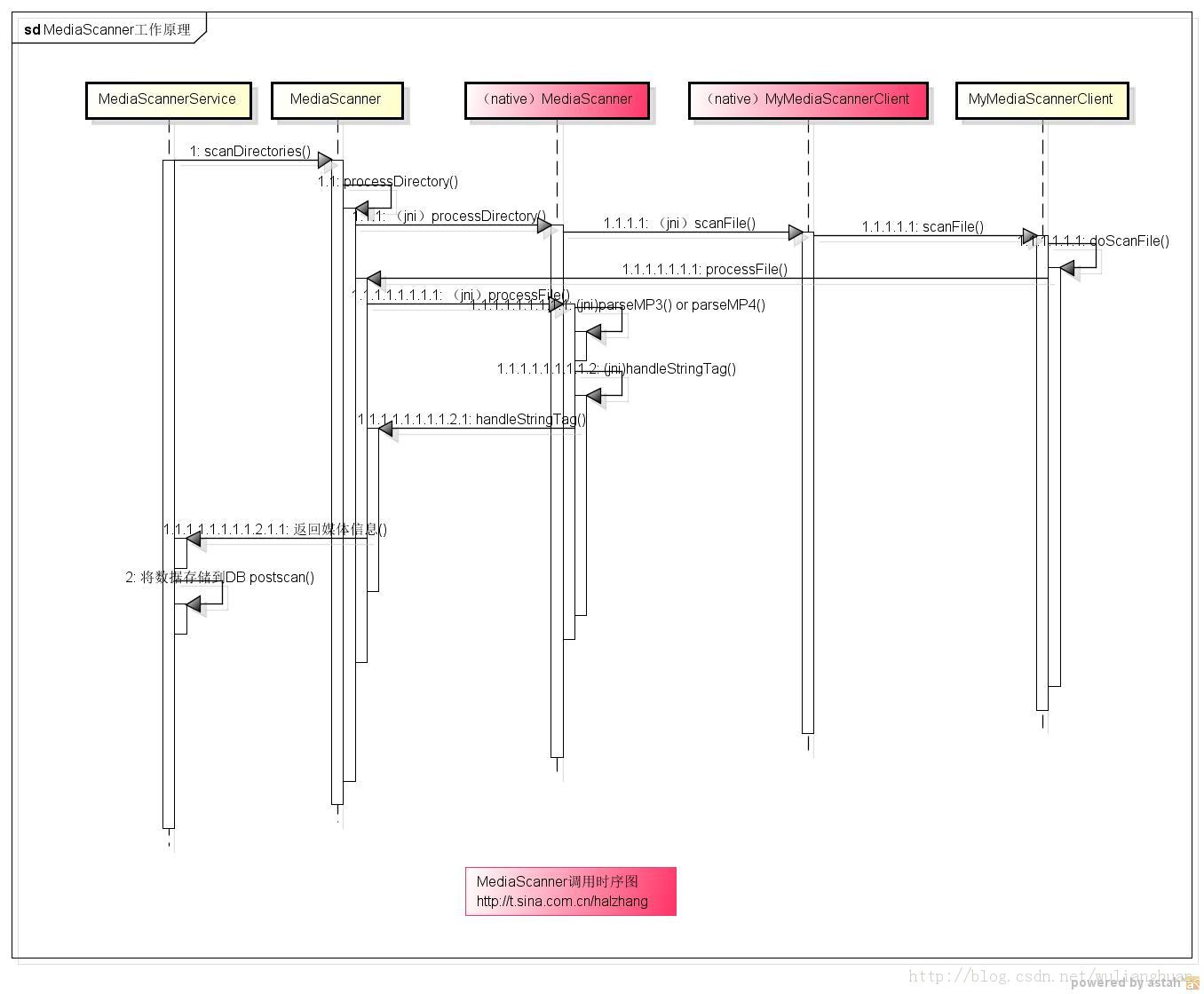
先看看java实现。
这个类巨复杂,而且和MediaProvider交互频繁。在分析的时候要时刻回到MediaProvider去
看看。
1. 初始化
在android.media.MediaScanner.MyMediaScannerClient中的scanFile方法是直接调用doScanFile的,来看看doScanFile
1:2: public Uri doScanFile(String path, String mimeType, long lastModified, long fileSize,3: boolean scanAlways) {4: Uri result = null;5: // long t1 = System.currentTimeMillis();6: try {7: FileCacheEntry entry = beginFile(path, mimeType, lastModified, fileSize);8: // rescan for metadata if file was modified since last scan9: if (entry != null && (entry.mLastModifiedChanged || scanAlways)) {10: String lowpath = path.toLowerCase();11: boolean ringtones = (lowpath.indexOf(RINGTONES_DIR) > 0);12: boolean notifications = (lowpath.indexOf(NOTIFICATIONS_DIR) > 0);13: boolean alarms = (lowpath.indexOf(ALARMS_DIR) > 0);14: boolean podcasts = (lowpath.indexOf(PODCAST_DIR) > 0);15: boolean music = (lowpath.indexOf(MUSIC_DIR) > 0)16: || (!ringtones && !notifications && !alarms && !podcasts);17:18: if (isMetadataSupported(mFileType)) {19: // 调用jni方法20: processFile(path, mimeType, this);21: } else if (MediaFile.isImageFileType(mFileType)) {22: // we used to compute the width and height but it's not23: // worth it24: }25:26: result = endFile(entry, ringtones, notifications, alarms, music, podcasts);27: }28: } catch (RemoteException e) {29: Log.e(TAG, "RemoteException in MediaScanner.scanFile()", e);30: }31: // long t2 = System.currentTimeMillis();32: // Log.v(TAG, "scanFile: " + path + " took " + (t2-t1));33: return result;34: }补充:result = endFile(entry, ringtones, notifications, alarms, music, podcasts);就是在这里将媒体数据信息存放到数据库的
7,接着是native的 processFile
1: static void2: android_media_MediaScanner_processFile(JNIEnv *env, jobject thiz, jstring path, jstring mimeType, jobject client)3: {4: MediaScanner *mp = (MediaScanner *)env->GetIntField(thiz, fields.context);5:6: if (path == NULL) {7: jniThrowException(env, "java/lang/IllegalArgumentException", NULL);8: return;9: }10:11: const char *pathStr = env->GetStringUTFChars(path, NULL);12: if (pathStr == NULL) { // Out of memory13: jniThrowException(env, "java/lang/RuntimeException", "Out of memory");14: return;15: }16: const char *mimeTypeStr = (mimeType ? env->GetStringUTFChars(mimeType, NULL) : NULL);17: if (mimeType && mimeTypeStr == NULL) { // Out of memory18: env->ReleaseStringUTFChars(path, pathStr);19: jniThrowException(env, "java/lang/RuntimeException", "Out of memory");20: return;21: }22:23: MyMediaScannerClient myClient(env, client);24: //调用MediaScanner的processFile25: mp->processFile(pathStr, mimeTypeStr, myClient);26: env->ReleaseStringUTFChars(path, pathStr);27: if (mimeType) {28: env->ReleaseStringUTFChars(mimeType, mimeTypeStr);29: }30: }8,mp->processFile(pathStr, mimeTypeStr, myClient);在此方法中根据不同的文件扩展名调用更加底层的解析方法,我想主要是ID3信息解析1: status_t MediaScanner::processFile(const char *path, const char* mimeType, MediaScannerClient& client)2: {3: status_t result;4: InitializeForThread();5: //初始化client6: client.setLocale(mLocale);7: client.beginFile();8:9: //LOGD("processFile %s mimeType: %s\n", path, mimeType);10: const char* extension = strrchr(path, '.');11: //根据扩展名调用不同的解析方法12: if (extension && strcasecmp(extension, ".mp3") == 0) {13: result = parseMP3(path, client);14: } else if (extension &&15: (strcasecmp(extension, ".mp4") == 0 || strcasecmp(extension, ".m4a") == 0 ||16: strcasecmp(extension, ".3gp") == 0 || strcasecmp(extension, ".3gpp") == 0 ||17: strcasecmp(extension, ".3g2") == 0 || strcasecmp(extension, ".3gpp2") == 0)) {18: result = parseMP4(path, client);19: } else if (extension && strcasecmp(extension, ".ogg") == 0) {20: result = parseOgg(path, client);21: } else if (extension &&22: ( strcasecmp(extension, ".mid") == 0 || strcasecmp(extension, ".smf") == 023: || strcasecmp(extension, ".imy") == 0)) {24: result = parseMidi(path, client);25: } else if (extension &&26: (strcasecmp(extension, ".wma") == 0 || strcasecmp(extension, ".aac") == 0)) {27: //TODO: parseWMA needs to be renamed to reflect what it is really doing,28: //ie. using OpenCORE frame metadata utility(FMU) to retrieve metadata.29: result = parseWMA(path, client);30: } else {31: result = PVMFFailure;32: }33: //调用client34: client.endFile();35:36: return result;37: }9,client.endFile()
1: void MediaScannerClient::endFile()2: {3: if (mLocaleEncoding != kEncodingNone) {4: int size = mNames->size();5: uint32_t encoding = kEncodingAll;6:7: // compute a bit mask containing all possible encodings8: for (int i = 0; i < mNames->size(); i++)9: encoding &= possibleEncodings(mValues->getEntry(i));10:11: // if the locale encoding matches, then assume we have a native encoding.12: if (encoding & mLocaleEncoding)13: convertValues(mLocaleEncoding);14:15: // finally, push all name/value pairs to the client16: for (int i = 0; i < mNames->size(); i++) {17: //在handleStringTag中是通过类反射的方法调用java中的handleStringTag18: if (!handleStringTag(mNames->getEntry(i), mValues->getEntry(i)))19: break;20: }21: }22: // else addStringTag() has done all the work so we have nothing to do23:24: delete mNames;25: delete mValues;26: mNames = NULL;27: mValues = NULL;28: }10,java中的handleStringTag,这个方法主要处理那些在底层解析后的数据返回到java层
1: public void handleStringTag(String name, String value) {2: if (name.equalsIgnoreCase("title") || name.startsWith("title;")) {3: // Don't trim() here, to preserve the special \001 character4: // used to force sorting. The media provider will trim() before5: // inserting the title in to the database.6: mTitle = value;7: } else if (name.equalsIgnoreCase("artist") || name.startsWith("artist;")) {8: mArtist = value.trim();9: } else if (name.equalsIgnoreCase("albumartist") || name.startsWith("albumartist;")) {10: mAlbumArtist = value.trim();11: } else if (name.equalsIgnoreCase("album") || name.startsWith("album;")) {12: mAlbum = value.trim();13: } else if (name.equalsIgnoreCase("composer") || name.startsWith("composer;")) {14: mComposer = value.trim();15: } else if (name.equalsIgnoreCase("genre") || name.startsWith("genre;")) {16: // handle numeric genres, which PV sometimes encodes like "(20)"17: if (value.length() > 0) {18: int genreCode = -1;19: char ch = value.charAt(0);20: if (ch == '(') {21: genreCode = parseSubstring(value, 1, -1);22: } else if (ch >= '0' && ch <= '9') {23: genreCode = parseSubstring(value, 0, -1);24: }25: if (genreCode >= 0 && genreCode < ID3_GENRES.length) {26: value = ID3_GENRES[genreCode];27: }28: }29: mGenre = value;30: } else if (name.equalsIgnoreCase("year") || name.startsWith("year;")) {31: mYear = parseSubstring(value, 0, 0);32: } else if (name.equalsIgnoreCase("tracknumber") || name.startsWith("tracknumber;")) {33: // track number might be of the form "2/12"34: // we just read the number before the slash35: int num = parseSubstring(value, 0, 0);36: mTrack = (mTrack / 1000) * 1000 + num;37: } else if (name.equalsIgnoreCase("discnumber") ||38: name.equals("set") || name.startsWith("set;")) {39: // set number might be of the form "1/3"40: // we just read the number before the slash41: int num = parseSubstring(value, 0, 0);42: mTrack = (num * 1000) + (mTrack % 1000);43: } else if (name.equalsIgnoreCase("duration")) {44: mDuration = parseSubstring(value, 0, 0);45: } else if (name.equalsIgnoreCase("writer") || name.startsWith("writer;")) {46: mWriter = value.trim();47: }48: }