
对Android App UI线程的一点理解
1. ANR
ANRs (“Application Not Responding”),意思是”应用没有响应“
发生ANR最常见的一种情况: UI线程中执行长时间的任务,如IO或网络操作, 导致UI线程5秒内没有响应输入事件
?
参考?http://blog.csdn.net/leilu2008/article/details/6689405
?
2. 如何避免ANR防止UI线程中执行长时间的任务,避免UI线程阻塞。 以Activity为例,我们应该避免在Activity的生命周期方法中执行耗时操作。
3. 问题Android系统创建UI线程时,同时在这个线程中启动了一个消息循环(Looper), Looper.loop()源码注释指出该方法可能阻塞。 这里的loop()显然是在UI线程中执行,不会阻塞UI线程吗?为什么没有引起ANR?
?
ActivityThread.java
?
public static final void main(String[] args) { ... ActivityThread thread = new ActivityThread(); thread.attach(false); ... Looper.loop(); ... }?
Looper.java
?
public static final void loop() { Looper me = myLooper(); MessageQueue queue = me.mQueue; // Make sure the identity of this thread is that of the local process, // and keep track of what that identity token actually is. Binder.clearCallingIdentity(); final long ident = Binder.clearCallingIdentity(); while (true) { Message msg = queue.next(); // might block //if (!me.mRun) { // break; //} if (msg != null) { if (msg.target == null) { // No target is a magic identifier for the quit message. return; } if (me.mLogging!= null) me.mLogging.println( ">>>>> Dispatching to " + msg.target + " " + msg.callback + ": " + msg.what ); msg.target.dispatchMessage(msg); if (me.mLogging!= null) me.mLogging.println( "<<<<< Finished to " + msg.target + " " + msg.callback); // Make sure that during the course of dispatching the // identity of the thread wasn't corrupted. final long newIdent = Binder.clearCallingIdentity(); if (ident != newIdent) { Log.wtf("Looper", "Thread identity changed from 0x" + Long.toHexString(ident) + " to 0x" + Long.toHexString(newIdent) + " while dispatching to " + msg.target.getClass().getName() + " " + msg.callback + " what=" + msg.what); } msg.recycle(); } } }?
4. Looper不会阻塞UI线程Looper不会阻塞UI线程。 原因是,UI线程消息循环开始后, UI线程内发生的所有操作(以Activity为例,比如Activity的生命周期的管理)都是通过这个消息循环来完成。即,Activity的生命回调方法(onCreate, onResume)最终都会以一种间接的方式由这个消息循环来调用。?
?
参考 ?http://stackoverflow.com/questions/6984263/android-looper-and-call-stack?
http://stackoverflow.com/questions/5193913/handlers-messagequeue-looper-do-they-all-run-on-the-ui-thread
?
5. 分析?
Activity启动时相关的几个类
?
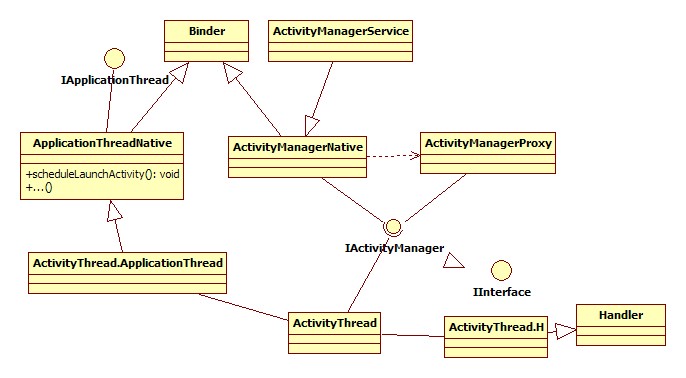
注意图中的ActivityManagerProxy和ActivityManagerService,后者为服务端, 前者可以看作它的远程代理。 ActivityThread通过这个代理进行IPC调用。另外, ActivityThread的一个类型为ApplicationThread(可以看出, 它间接地继承自Binder, 并且是ActivityThread的内部类)成员变量作为远程调用的参数被传递给了ActivityManagerService, 这里的ApplicationThread是ActivityManagerService能够调用Activity的回调方法的关键。
?
Activity启动的时序图
?
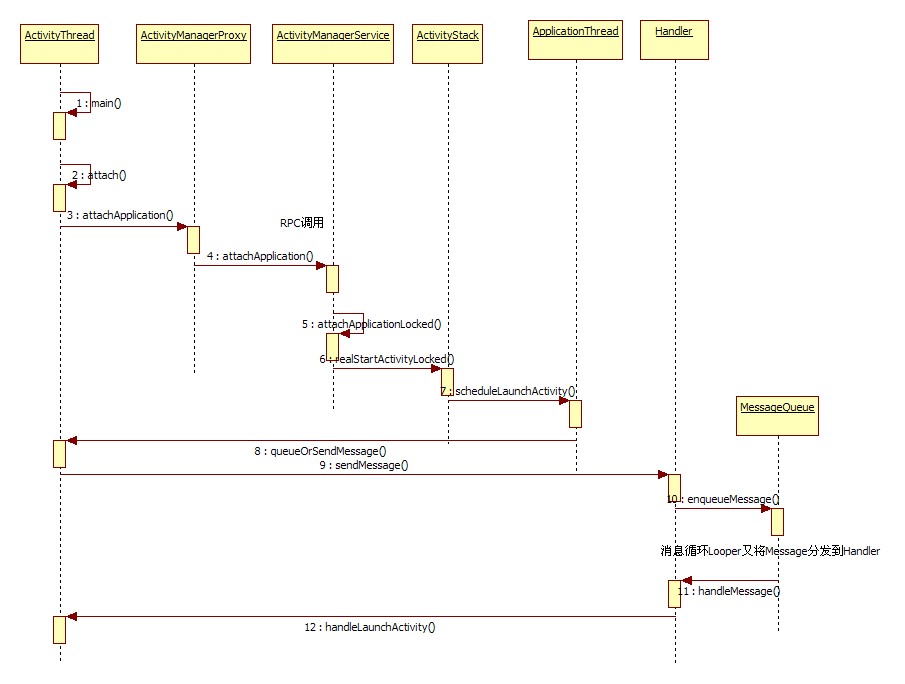
由上图可以看出,一系列调用过程最终结果是一个相应Message进入MessageQueue, 由ActivityThread的一个Handler成员变量进行消息的处理。其处理流程基本可归纳为
handleXXXActivity() ----> performXXXActivity()---->Instrument.callActivityOnXXX()--->Activity.onXXX()
这里的Activit.onXXX()就是我们编写的Activity生命周期方法。
?
所以说Activity的生命周期方法是通过UI线程的消息循环来完成, 并不存在Looper阻塞UI线程的问题。我们需要注意的就是避免在这些回调方法中执行耗时操作。
?