
Hadoop MapReduce数据流程(上)本文不涉及MapReduce的原理介绍,只是从源代码的层面讲讲我对Hadoop的MapRedu
Hadoop MapReduce数据流程(上)
本文不涉及MapReduce的原理介绍,只是从源代码的层面讲讲我对Hadoop的MapReduce的执行过程、数据流的一点理解。
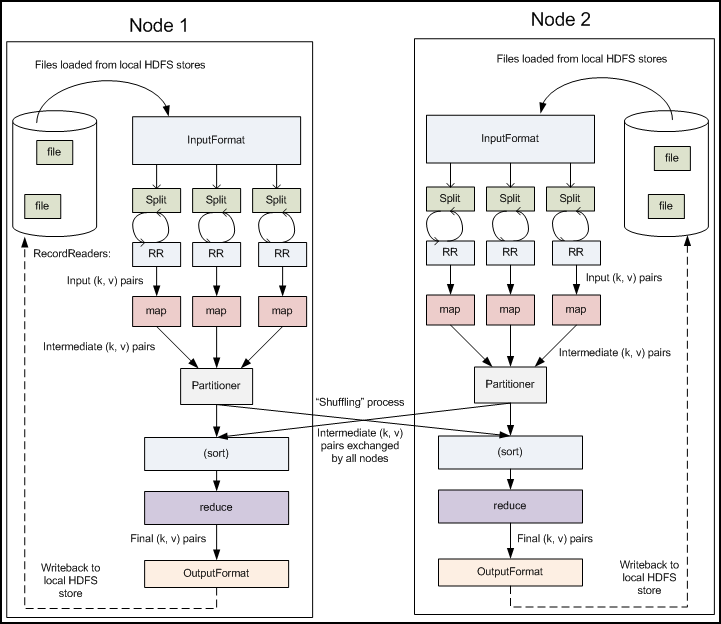
首先贴上一张来之于Yahoo Hadoop 教程的图片
?
由上图可以看出,在进入Map之前,InputFormat把存储在HDFS的文件进行读取和分割,形成和任务相关的InputSplits,然后RecordReader负责读取这些Splits,并把读取出来的内容作为Map函数的输入参数。下面我就从代码执行的角度来看,数据是如何一步步从HDFS的file到Map函数的。在Yahoo Hadoop 教程中已经详细讲解了这一过程。但我作为一个细节控,更想从源代码的级别去理清这一过程,这样我才觉得踏实,才觉得自己真真切切地掌握了这个知识点,因此我仔细阅读了这部分的源代码,写篇博客记录下来,以便以后自己查看。
首先,在Mapper类的run方法中,map函数被循环调用:
public class Mapper<KEYIN, VALUEIN, KEYOUT, VALUEOUT> { ................................... /** * Expert users can override this method for more complete control over the * execution of the Mapper. * @param context * @throws IOException */ public void run(Context context) throws IOException, InterruptedException { setup(context); while (context.nextKeyValue()) { map(context.getCurrentKey(), context.getCurrentValue(), context); } cleanup(context); } ????????? 在run方法中,每调用一次context.nextKeyValue(),就执行一遍map方法,而此处的context实际上是实现了Context接口的MapContextImpl(这一点可以在MultithreadedMapper的run方法看出来),其nextKeyValue,getCurrentKey,getCurrentValue方法为:
@Override public boolean nextKeyValue() throws IOException, InterruptedException { return reader.nextKeyValue(); } @Override public KEYIN getCurrentKey() throws IOException, InterruptedException { return reader.getCurrentKey(); } @Override public VALUEIN getCurrentValue() throws IOException, InterruptedException { return reader.getCurrentValue(); }?????? 上述代码中的实际上是由reader来完成nextKeyValue的工作,reader是RecordReader实例,RecordReader就是用来读取各个task的splits,产生map函数的输入参数。实现RecordReader接口的类由很多,那此处的reader到底是那个类的实例呢?我们到创建context的地方去看一看。org.apache.hadoop.mapreduce.RecordReader<INKEY,INVALUE> input = new NewTrackingRecordReader<INKEY,INVALUE> (inputFormat.createRecordReader(split, taskContext), reporter); job.setBoolean(JobContext.SKIP_RECORDS, isSkipping()); org.apache.hadoop.mapreduce.RecordWriter output = null; .............. org.apache.hadoop.mapreduce.MapContext<INKEY, INVALUE, OUTKEY, OUTVALUE> mapContext = new MapContextImpl<INKEY, INVALUE, OUTKEY, OUTVALUE>(job, getTaskID(), input, output, committer, reporter, split);??? 上面代码中的input是一个NewTrackingRecordReader实例,而NewTrackingRecordReader则是对inputFormat.createRecordReader(split, taskContext), reporter)返回的RecordReader对象的封装,inputFormat是InputFormat类的实例,InputFormat类定义了如何分割可读取文件,
public abstract class InputFormat<K, V> { public abstract List<InputSplit> getSplits(JobContext context ) throws IOException, InterruptedException; public abstract RecordReader<K,V> createRecordReader(InputSplit split, TaskAttemptContext context ) throws IOException, InterruptedException;}??? 读取文件主要是通过其创建的RecordReader来完成的。Hadoop自带了好几种输入格式,关于输入格式的具体描述可以参考此处Yahoo Hadoop 教程。JobContextImpl中包括了InputFormat的get和set方法,默认的实现是TextInputFormat---读取文件的行,行的偏移量为key,行的内容为value。我们可以通过重写InputFormat中的isSplitable和createRecordReader来实现自定义的InputFormat,并通过JobContextImpl中的set方法来在map中采用自己的输入格式。 @SuppressWarnings("unchecked") public Class<? extends InputFormat<?,?>> getInputFormatClass() throws ClassNotFoundException { return (Class<? extends InputFormat<?,?>>) conf.getClass(INPUT_FORMAT_CLASS_ATTR, TextInputFormat.class); }?因为读物文件是通过RecordReader完成的,因此接下来看看TextInputFormat中的RecordReader是什么?public class TextInputFormat extends FileInputFormat<LongWritable, Text> { @Override public RecordReader<LongWritable, Text> createRecordReader(InputSplit split, TaskAttemptContext context) { String delimiter = context.getConfiguration().get( "textinputformat.record.delimiter"); byte[] recordDelimiterBytes = null; if (null != delimiter) recordDelimiterBytes = delimiter.getBytes(); return new LineRecordReader(recordDelimiterBytes); } @Override protected boolean isSplitable(JobContext context, Path file) { ...................... }}??? 可见,TextInputFormat中,创建的RecordReader为LineRecordReader,”textinputformat.record.delimiter“指的是读取一行的数据的终止符号,即遇到“textinputformat.record.delimiter”所包含的字符时,该一行的读取结束。可以通过Configuration的set()方法来设置自定义的终止符,如果没有设置textinputformat.record.delimiter,那么Hadoop就采用以CR,LF或者CRLF作为终止符,这一点可以查看LineReader的readDefaultLine方法。查看LineRecordReader的实现就知道为什么上面说TextInputFormat是以行的偏移量为key,行的内容为value了。来看看其中的几个主要的方法: public void initialize(InputSplit genericSplit, TaskAttemptContext context) throws IOException { FileSplit split = (FileSplit) genericSplit; ...... start = split.getStart(); end = start + split.getLength(); final Path file = split.getPath(); // open the file and seek to the start of the split final FileSystem fs = file.getFileSystem(job); fileIn = fs.open(file); if (isCompressedInput()) { decompressor = CodecPool.getDecompressor(codec); if (codec instanceof SplittableCompressionCodec) { final SplitCompressionInputStream cIn = ((SplittableCompressionCodec)codec).createInputStream( fileIn, decompressor, start, end, SplittableCompressionCodec.READ_MODE.BYBLOCK); if (null == this.recordDelimiterBytes){ in = new LineReader(cIn, job); } else { in = new LineReader(cIn, job, this.recordDelimiterBytes); } start = cIn.getAdjustedStart(); end = cIn.getAdjustedEnd(); filePosition = cIn; } else { if (null == this.recordDelimiterBytes) { in = new LineReader(codec.createInputStream(fileIn, decompressor), job); } else { in = new LineReader(codec.createInputStream(fileIn, decompressor), job, this.recordDelimiterBytes); } filePosition = fileIn; } } else { fileIn.seek(start); if (null == this.recordDelimiterBytes){ in = new LineReader(fileIn, job); } else { in = new LineReader(fileIn, job, this.recordDelimiterBytes); } filePosition = fileIn; } } public boolean nextKeyValue() throws IOException { if (key == null) { key = new LongWritable(); } key.set(pos); if (value == null) { value = new Text(); } int newSize = 0; // We always read one extra line, which lies outside the upper // split limit i.e. (end - 1) while (getFilePosition() <= end) { newSize = in.readLine(value, maxLineLength, Math.max(maxBytesToConsume(pos), maxLineLength)); if (newSize == 0) { break; } pos += newSize; inputByteCounter.increment(newSize); if (newSize < maxLineLength) { break; } } if (newSize == 0) { key = null; value = null; return false; } else { return true; } } @Override public LongWritable getCurrentKey() { return key; } @Override public Text getCurrentValue() { return value; }? 首先在initialize方法里,根据传入的FileSplit来获取到当前读取文件的path,起始位置,并以此创建真正的文件读取流in,我们可以看见在nextKeyValue方法里,就是由in来读取文件,更新key和value的值。? 至此,Hadoop如何把文件数据读取出来,并以何种方式传给Map函数,就一目了然了,同时也更加理解了Yahoo Hadoop 教程里面提到的譬如FileInputFormat的默认实现,TextInputFormat是如何实现Key-Value组合等等内容。最大的好处在于,如果我要实现一些自定义的东西,我应该如何去修改代码,如何去在合适的地方嵌入自定义的东西。?
?
1 楼 waytofall 2011-06-05 兄弟你这源码能发一份吗?waytofall916@gmail.com
hadoop包里源码和jar的版本竟然不匹配啊…… 2 楼 waytofall 2011-06-05 waytofall 写道兄弟你这源码能发一份吗?
waytofall916@gmail.com
hadoop包里源码和jar的版本竟然不匹配啊……
哦,好吧,我看错了……
原来在另一个mapreduce包里……
嗯,文章写得不错,赞钻研精神~
(新版和旧版很坑爹) 3 楼 austincao 2012-07-23 看来我也要潜下心来,多看看代码了,谢谢LZ分享这么好的文章,学习了~