
基本信息·出版社:高等教育出版社 ·页码:367 页 ·出版日期:2007年12月 ·ISBN:7040189380 ·条形码:9787040189384 ·版本:第1版 ·装帧:平装 · ...
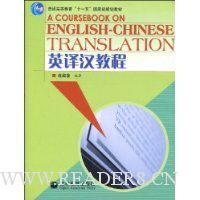
基本信息·出版社:高等教育出版社
·页码:367 页
·出版日期:2007年12月
·ISBN:7040189380
·条形码:9787040189384
·版本:第1版
·装帧:平装
·开本:16
·正文语种:英语/中文
·丛书名:普通高等教育“十一五”国家级规划教材
内容简介 《英译汉教程》将翻译理论课、技巧课和实践课融为一体,提供了一套可供课堂操作的英汉翻译基础教程。 本教材主要供高等院校英语专业本科高年级或同等程度的学生作为英汉翻译课在课堂教学中使用,也可供有同等英语水平的翻译自学者使用。
作者简介 连淑能(1942-),厦门大学外文学院教授、博士生导师,荣获国务院颁发的政府特殊津贴。1996—1999年任厦门大学外文系系主任,1999—2003年任外文学院院长,现兼任中国英汉语比较研究会副会长、中国人文社会科学核心期刊《外语与外语教学》顾问和编委等。曾任驻外大使馆和专家组翻译,赴英国牛津大学和剑桥大学、美国俄勒冈大学和威拉姆特大学讲学、研究。荣获福建省“三育人先进个人”称号、厦门市优秀教师称号、厦门大学最高奖“南强奖”一等奖(合作)、厦门大学研究生“良师益友”称号等。主要研究方向为汉英语言与中西文化、翻译理论与技巧、跨文化交际学,已发表80多篇论文和18部论著、编著、译著,合作承担国家863计划课题“自然语言理解与机器翻译”,荣获20多项奖项。代表作《英汉对比研究》荣获国家教委颁发的第二届全国高等学校出版社优秀学术著作优秀奖、福建省第三届社会科学优秀成果一等奖,并被选送参加国际书展。
编辑推荐 《英译汉教程》是由高等教育出版社出版的。
目录
Chapter1 GeneraIPrlnclples 1
1.1 What is Translation? 1
1.1.1 Linguistic Views on Translation 1
1.1.2 Cultural Views on Translation 1
1.1.3 Literary Views on Translation 2
1.1.4 Semantic Views on Translation 2
1.1.5 Functional Views on Translation 3
1.1.6 Communicative Views on Translation
1.2 The Assessment of Translation 3
1.2.1 Translation Criteria Put Forward by Famous Translators or Tra
1.2.2 Other Factors Affecting the Evaluation of Translation
1.2.3 Criteria for Beginners of Translation 7
1.2.4 Translation Proficiency: the Requirements of the Teach English Major
1.3 The Competence of a Translator 8
1.3.1 Excellent Command of the Two Languages 8
1.3.2 Considerable Knowledge of the Two Cultures 9
1.3.3 Adequate Knowledge of the Subject Matter 11
1.3.4 Fair Capacity for Writing 11
1.3.5 Plenty of Practice and Adequate Knowledge of Transl Skills 11
1.3.6 Skills in the Use of Information Technology 12
1.4 Translation Strategies 12
1.4.1 Literal Translation and Free Translation 12
1.4.2 Foreignizing Translation and Domesticating Translation
1.4.3 Style and Translation 15
1.5 Basic Processes in Translating 19
1.5.1 The Four-phase Process in Translating 19
1.5.2 Some Dos and Don'ts for Students 21
1.5.3 Procedures of Translation by a Team 21
Chapter 2 Contrastlve Studies of English and Chinese 25
2.1 Studies of the English Language 25
2.1.1 External History: Historical Information Related to the English Language 25
2.1.2 Internal History: a Linguistic Review 28
2.1.3 Some Characteristics of English 29
2.2 Studies of the Chinese Language 31
2.2.1 Some Major Factors Affecting the Chinese Language 31
2.2.2 Some Characteristics of Modern Chinese 32
2.3 English vs. Chinese: Ten Pairs of Features 38
2.3.1 Synthetic vs. Analytic (综合语与分析语) 38
2.3.2 Rigid vs. Supple (刚性与柔性) 44
2.3.3 Hypotactic vs. Paratactic (形合与意合) 47
2.3.4 Complex vs. Simplex (繁复与简短) 49
2.3.5 Impersonal vs. Personal (物称与人称) 50
2.3.6 Passive vs. Active (被动与主动) 52
2.3.7 Static vs. Dynamic (静态与动态) 54
2.3.8 Abstract vs. Concrete (抽象与具体) 55
2.3.9 Indirect vs. Direct (间接与直接) 56
2.3.10 Substitutive vs. Repetitive (替换与重复) 59
Conclusion 66
Chapter3 DIction(选词法) 67
3.1 Choice of Affective Meanings 67
3.2 Choice of Grammatical Meanings 70
3.3 Choice of Contextual Meanings 71
3.4 Choice of Collocative Meanings 72
3.5 Choice of Stylistic Meanings 74
3.6 Choice of Ambiguous Meanings 81
3.7 Choice of Extended Meanings 83
3.8 Choice of Equivalent Meanings 87
3.9 Choice of Exact Meanings 92
3.10 Choice of Different Chinese Words to Translate the Same English Word or Use of the
Same Chinese Word(s) to Translate Different English Words 95
Conclusion 102
Chapter 4 Conversion(转换法) 103
4.1 Conversion of Word Classes 103
4.2 Conversion of Sentence Members 1 14
4.3 Conversion of Impersonal Subjects 1 18
4.4 Conversion of Perspectives 125
Conclusion 1 28
Chapter 5 Addltion(增神法) 129
5.1 Structural Addition 129
5.2 Semantic Addition 130
5.3 RhetoricaI Addition 140
Conclusion 1 44
Chapter 6 Omission(省略法) 146
6.1 Omission of Words Peculiar to English 146
6.2 Omission of Words Superfluous in Chinese 149
Conclusion 1 62
Chapter 7 Repetition(重复法) 164
7.1 Grammatical Repetition 1 65
7.2 Rhetorical Reduplication and Repetition 170
Conclusion 1 83
Chapter 8 Invorslon(倒置法) 164
8.1 Inversion of Word Order in Translating Word-Groups or Phrases 184
8.2 Inversion of Word Order in Translating Attributes 185
8.3 Position of Adjective Clauses 188
8.4 Inversion of Adverbials 1 93
8.5 Position of Adverbial Clauses 194
8.6 Inversion of Sentence Structure 196
rnnchLlsinn 205
Chapter 9 Negation (反译法) 208
9.1 Transfer of the Negative 208
9.2 Conversion of the Affirmative into the Negative 211
9.3 Conversion of the Negative into the Affirmative 213
9.4 Translation of English Questions and Answers 216
9.5 Translation of Various Kinds of Negations 220
Conclusion 251
Chapter10 Dlvlslon(拆译法) 252
10.1 Picking Out of Words 252
10.2 Picking Out of Phrases 254
10.3 Splitting of Complex Sentences 256
10.4 Splitting of the Whole Sentence 262
Conclusion 268
Chapter11 Condensation(缩译法) 270
11.1 Condensation of Phrases and Clauses 270
11.2 Condensation of Complex Sentences into Simple Sentences 271
11.3 Condensation of Compound Sentences into Simple Sentences 273
11.4 Condensation of Two or More Simple Sentences into One Simple Sentence 273
Conclusion 276
Chapter 12 Translation of the Passive(被动与译法) 277
12.1 Features of the English Passive 277
12.2 Features of the Chinese Passive 279
12.3 Common Ways to Translate the English Passive 282
Conclusion 289
Chapter 13 Translation of Long Sentences(长句译法) 290
13.1 Features of Long English Sentences 290
Chapter 14 Translation of Culture-loaded Expressions
Chapter 15 Transaltion of Proper Nouns and Technical Terms
……
序言 本教材主要供高等院校英语专业本科高年级或同等程度的学生作为英汉翻译课在课堂教学中使用,也可供有同等英语水平的翻译自学者使用。
本教材试图将翻译理论课、技巧课和实践课融为一体,提供一套可供课堂操作的英汉翻译基础教程。为了提高教学效果,编者主要在以下几个方面作了努力:
1.针对学生的水平和可能遇到的问题,尽力符合《高等学校英语专业英语教学大纲》(2000:10,以下简称《大纲》)对英语专业六级的英译汉教学要求:“初步了解翻译基础理论和英、汉两种语言的异同,并掌握常用的翻译技巧,能将中等难度的英语篇章或段落译成汉语。译文忠实原文,语言通顺,速度为每小时250~300个英文单词。”
英语专业三年级学生经过了一、二年级“阅读”、“语法”和“写作”等基础课程的训练,对中等难度的英语篇章或段落虽有了一定的理解能力,但准确理解原文并用通顺的汉语表达,仍然有不少困难。如何将原文忠实地翻译成通顺的汉语,是需要解决的问题。这类学生修完了二年级的英语语法课程,进入三、四年级系统翻译训练的入门阶段,比较能够适应的是与英语语法相联系的传统翻译基础教程。此外,根据调查结果,“翻译教材用户肯定并普遍欢迎传统教材的编写体系与翻译技巧”(张美芳:《中国英汉翻译教材研究》1949-1998,2001:146)。因此,本教材主要以传统翻译教材的编写体系与翻译技巧为基础编写,兼顾篇章翻译法,同时,也适当地引入翻译功能流派和当代译论流派的某些理论或观点,为学生进一步学习和研究打好基础。
文摘 Drills 10.4
6. All was cleared up some time later when news came from a distant place that anearthquake was felt the very day the little copper ball fell.
7. When I try to understand what it is that prevents so many Americans from being ashappy as one might expect, it seems to me that there are two causes, of which onegoes much deeper than the other.
8. Could any spectacle, for instance, be more grimly whimsical than that of gunnersusing science to shatter men's bodies while, close at hand, surgeons use it to restorethem?
9. He boasts that a slave is free the moment his foot touches British soil and he sells thechildren of the poor at six years of age to work under the lash in the factories forsixteen hours a day. (B. Shaw: The Man of Destiny)
10. There is nothing more disappointing to a hostess who has gone to a lot of trouble orexpense than to have her guest so interested in talking politics or business with herhusband that he fails to notice the flavor of the coffee, the lightness of the cake, or theattractiveness of the house, which may be her chief interest and pride. (Western Man-ners)
Thus, despite its extraordinary achievements in art, science, intellectual, moral andpolitical life, the United States is a nation in which tens of thousands of young people fleereality by opting for drug-induced lassitude; a nation in which millions of their parents retreatinto video-induced stupor or alcoholic haze; a nation in which legions of elderly folk vegetateand die in loneliness; in which the flight from family and occupational responsibility hasbecome an exodus; in which masses tame their raging anxieties with Miltown, or Librium, orEquanil, or a score of other tranquilizers and psychic pacifiers. Such a nation, whether itknows it or not, is suffering from future shock. (Alvin Toffler: Future Shock)