
基本信息·出版社:外文出版社 ·页码:340 页 ·出版日期:2009年07月 ·ISBN:9787119020150 ·条形码:9787119020150 ·版本:第1版 ·装帧:精装 ·开 ...
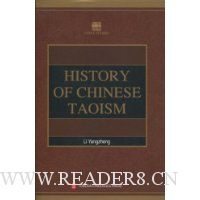
基本信息·出版社:外文出版社
·页码:340 页
·出版日期:2009年07月
·ISBN:9787119020150
·条形码:9787119020150
·版本:第1版
·装帧:精装
·开本:16
·正文语种:英语
内容简介 《中国道教史(英文版)》介绍了:Compiled according to An Outline History of Chinese Taoism by the Chinese Taoist Association,and a series of works by Professor Li Yangzheng of the Chincse Taoisr College,this book also contains related research findings from both within and outside China.Composed of seven chapters,the book gives an overall systematic introduction to the past and present of Chinese Taoism,including basic concepts of Taoism,pracuces,scriptures,organizations.Taoist figures,immortals.Taoist temples,and health preservation.The book provides extensive detailed and accurate data,as well as insightful perspectives through advanced academic achievements,and is therefore of significant historical value for greater understanding and study of Chinese Taoism.culture and folk customs.
作者简介 Li Yangzheng,a researcher in Taoism,was born in t 925 in Gong'an County,Hubei Province,and graduated from National Wuhan University in 1949.When the Chinese Taoist Association was founded in 1957,he joined the organization and devoted himself to Taoist research under the guidance of the reputed Taoist scholar Chen Yingning.Li Yangzheng used to be the Deputy,Dean of the Chinese Taoist College.His published works indude An Introduction to Taoism.Taoism and Chinese Society,Modern Chinese Taoism,Taoism and Various Pre-Qin Schools of Thought,among others.He has also compiled A Handbook of Taoism,The Taoist Culture Series,A Collection of Materials on the History of Taoism,The Great Dictionary of Taoism (with coeditor Min Zhiting),etc.,as well as published almost a hundred academic articles.
编辑推荐 《中国道教史(英文版)》由外文出版社出版。
目录
Preface
Foreword
Introduction: What Is Tao?
Chapter One The Origin of Taoist Religion (From Antiquity to c. A.D. 142)
Section Ⅰ Sources of Taoist Belief and Pantheon
Section Ⅱ Sources of Taoist Religious Thinking
Section Ⅲ The FormatⅣe Process of Taoist Organization
Chapter Two Early Phase of Taoism (142-220)
Section Ⅰ The Great Peace Scripture (Taipingjing) and Great Peace Taoism (Taiping Tao)
Section Ⅱ The Wudoumi Tao (FⅣe Bushels of Rice Movement)
Section Ⅲ Wei Boyang and Can, Tong Qi, the Earliest Taoist Scripture on Alchemy
Chapter Three Reformation and Maturation of Taoism(220-581)
Section Ⅰ The Wei Regime's Control of Taoism and the Shift of the Taoist Center to Jiangnan
Section Ⅱ Ge Hong, the Greatest Theorist of Immortalist Taoism
Section Ⅲ The Rebellion of the “Immortal Men”
Section Ⅳ The Emergence of Three Scriptural Traditions
Section Ⅴ Kou Qianzhi and the Northern Celestial Master Movement
Section Ⅵ Lou Guan Taoist Tradition
Section Ⅶ Lu Xiujing and the Southern Celestial Master Movement
Section Ⅷ Tao Hongjing and the Maoshan Tradition
Chapter Four The Prime Time of Taoism (581-960)
Section Ⅰ Taoism as the Religion of the Tang Royal Family
Section Ⅱ Development of Taoist Doctrines
Section Ⅲ Emergence of the Inner-Alchemical Tradition in the Tang and FⅣe Dynasties Periods
Section Ⅳ Kaiyuan Daozang; the Earliest Edition of the Taoist Canon
Chapter Five The Growth of Taoist Schools (960-1368)
Section Ⅰ Support of Taoism by the Song Emperors
Section Ⅱ Flourishing of the Inner Alchemical School in the Song-Yuan Period
Section Ⅲ Development of New Talismanic Schools in the South
Section Ⅳ Emergence of New Taoist Schools in Northern China
Section Ⅴ Compilations and Revisions of the Taoist Canon and Other Impo~nt Scriptures of the Song-Yuan Period
Chapter Six Taoism During the Ming and Qing Dynasties (1368-1911)
Section Ⅰ Taoism and Its Relation with Ming Emperors
Section Ⅱ The Wudang Taoist Tradition and New Branches of the Inner-Alchemical School
Section Ⅲ Wang Chongyue's Longmen Art of Mind Cultivation and Lou Jinyuan's Yellow Register Liturgy
Section Ⅳ Penetration of Taoism into the Folk Traditions
Section Ⅴ Taoist Canons and Scriptures in the Ming-Qing Period
Chapter Seven Taoism in the Modern Age
Section Ⅰ Taoism in the Republic of China (1911-1949)
Section Ⅱ Taoism in the People's Republic of China(1949-)
Section Ⅲ Taoist Presence Outside Chinese Mainland
Section Ⅳ Taoist Monasteries on the Mainland
Epilogue Taoism and Chinese Culture
Appendix Ⅰ Interaction Between Taoism and Buddhism in China
Ⅰ. The Rise of Taoism and the Entry of Buddhism into China
Ⅱ. Efforts Toward Mutual Toleration During the Han, Wei and Jin Dynasties
Ⅲ. The Struggle for Supremacy During the Southern and Northern Dynasties Period
Ⅳ. The Buddhist Catastrophe During the Tang Dynasty and the Burning of Taoist Canons During the Yuan Dynasty
Appendix Ⅱ Constitution of the Chinese Taoist Association
Appendix Ⅲ Rules of the Chinese Taoist Association on Administration of Taoist Monasteries and Temples
Appendix Ⅳ Regulations of the Chinese Taoist Asso- ciation on Administration of Non-resident Zhengyi Taoist Priests
Bibliography
Index
……
序言 The study of Taoism is growing stronger everyday both in Eastand West. Taoist-related ideas and practices are becoming morecommon and tend to transform our lifestyles and world views.Scores of Western scholars have contributed to this new stream ofinspiration, but pioneering work has also been initiated in China andJapan, although their work is more rarely known by Westerners.
Here, for the first time, we have a scholarly work on Taoismwritten in English by a Chinese scholar. It is based on Chinesesource materials and reflects a Chinese understanding of the Taoisttradition.
I have been invited by the compiler Yan Zhonghu to write thispreface and was happy to comply. This book contains much infor-mation that is missing in comparable Western works. At this mo-ment there is no complete treatment of Taoism in the West, and thetime is ripe for such a project to be undertaken. The present work isa positive step in that direction, although it cannot yet be regardedas complete in all its aspects.
文摘 By holding thejing, shen and qi in one entity, a man is expectedto become an immortal. Holding fast to life characterizes the Taoistteachings throughout history. It is understandable that a fabulousnumber of arts has been tried and recorded in Taoist literature.Many of these arts have either spiritual value for elevating the mindof the people who practice them, or medical value for curing theirdiseases or at least maintaining sound health. In the Taipingjing, asignificant number of arts have been recorded, besides the art ofshouyi, the fact shows that from the very beginning Taoism placed ahigh value on arts and practices. The soul of Taoist Religion, so tospeak, lies in its belief in immortality and the rich arts geared for itsattainment. It was only after Buddhism gained strength in Chinaand gradually eroded Taoist sphere of influence that Taoism beganto take on a more sophisticated theoretical dimension. We will dis-cuss Taoist theology in later chapters.